



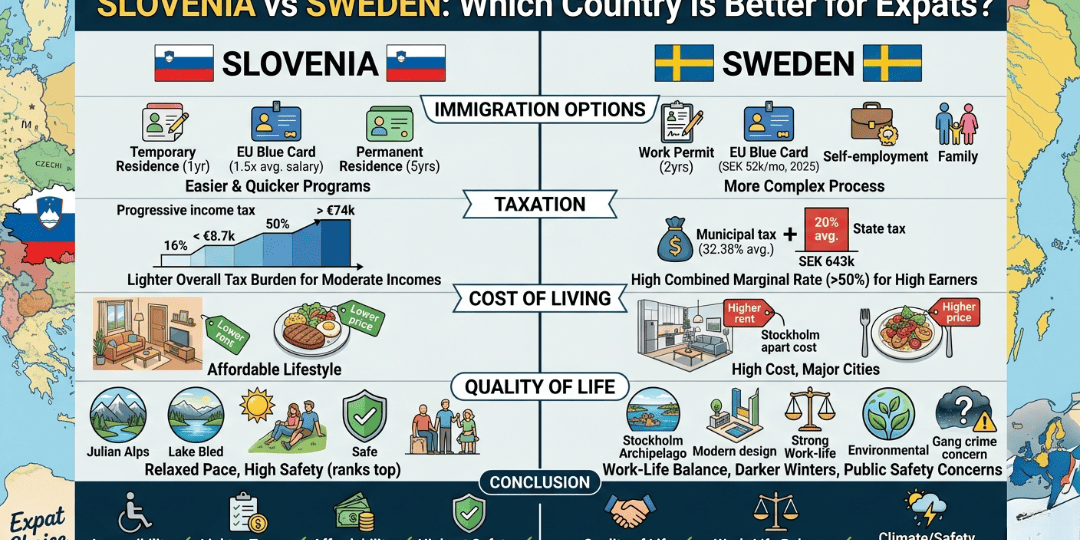
Slovenia vs Sweden: Which Country is Better for Expats?
When considering a move to Europe as an expat, you may be weighing your options between various countries. Two attractive destinations that often come up are Slovenia and Sweden. In this article, we’ll compare these two countries in terms of immigration, taxation, cost of living, and quality of life to help you make the best choice for your expat journey.
Immigration Options
Slovenia has a relatively straightforward immigration process for expats:
- Temporary Residence Permit: Issued for employment, study, family reunion, or other purposes. Valid for up to one year and can be renewed.
- EU Blue Card: For highly skilled workers with a university degree and a qualifying job offer. Slovenia sets the minimum salary threshold at 1.5 times the average gross annual salary, recalculated annually by the national statistics office.
- Permanent Residence Permit: Can be obtained after 5 years of continuous legal residence in Slovenia.
Sweden offers several residence permit options for expats, but the process is often more complex:
- Work Permit: Requires a job offer from a Swedish employer and is valid for up to two years.
- EU Blue Card: For highly qualified professionals. The current minimum salary threshold is SEK 52,000 per month (effective from July 9, 2025), as published by the Swedish Migration Agency.
- Self-employment Visa: For entrepreneurs looking to start a business in Sweden.
- Residence Permit for Relations: Allows close family members to join you in Sweden.
Slovenia’s immigration programs are generally more accessible and quicker compared to Sweden’s, making it a more attractive option for many expats.
Taxation
Slovenia applies a progressive personal income tax system with five brackets (as of 2026):
- 16% on income up to €8,755
- 26% on income from €8,755 to €25,750
- 33% on income from €25,750 to €51,500
- 39% on income from €51,500 to €74,160
- 50% on income above €74,160
Social security contributions in Slovenia are shared between employer and employee, with the employee-side burden generally lower than in Sweden.
Sweden’s tax system combines municipal income tax (averaging 32.38% in 2026, varying by municipality) with an additional state income tax of 20% on taxable earned income above SEK 643,000. This means most employees pay around 30–35% on regular salaries, while higher earners face a combined marginal rate above 50%. Sweden also has mandatory social security contributions paid primarily by employers.
For expats earning moderate incomes, Slovenia generally offers a lighter overall tax burden, allowing you to retain a larger portion of your earnings.
Cost of Living
Slovenia, while not the cheapest country in Europe, offers a more affordable lifestyle compared to Sweden. Rent prices are significantly lower than in Swedish cities like Stockholm and Gothenburg, and dining out is also more budget-friendly. Slovenia’s smaller size also means that transportation costs are generally lower.
Sweden has a high cost of living, particularly in its major cities. Rent, food, transportation, and entertainment costs are among the highest in Europe.
Expats can maintain a high standard of living in Slovenia without the high costs associated with living in Sweden.
Quality of Life
Both Slovenia and Sweden offer a high quality of life, with excellent healthcare, education, and infrastructure.
Slovenia boasts breathtaking scenery, with the Julian Alps, Adriatic coast, and Lake Bled being major draws. Slovenia also has a rich cultural heritage, a thriving food and wine scene, and a more relaxed pace of life. Importantly, Slovenia consistently ranks as one of the safest countries in Europe, with very low crime rates. Expats in Slovenia can enjoy a laid-back lifestyle while still having access to modern amenities.
Sweden is known for its stunning natural landscapes, from the Arctic north to the picturesque islands of the Stockholm Archipelago. It also has a strong focus on work-life balance, gender equality, and environmental sustainability. However, Sweden’s climate can be challenging, with long, dark winters and short summers. In recent years, growing concerns around gang-related crime in some urban areas have also affected public perception of safety.
Conclusion
While both Slovenia and Sweden are excellent destinations for expats, Slovenia offers several advantages:
- More accessible and straightforward immigration programs
- A progressive but generally lighter tax burden for moderate earners
- More affordable cost of living
- Stunning natural beauty, a relaxed lifestyle, and one of the highest safety levels in Europe
If you’re looking for a welcoming, affordable, and picturesque country to call home, Slovenia might just be the perfect choice for your expat adventure.