



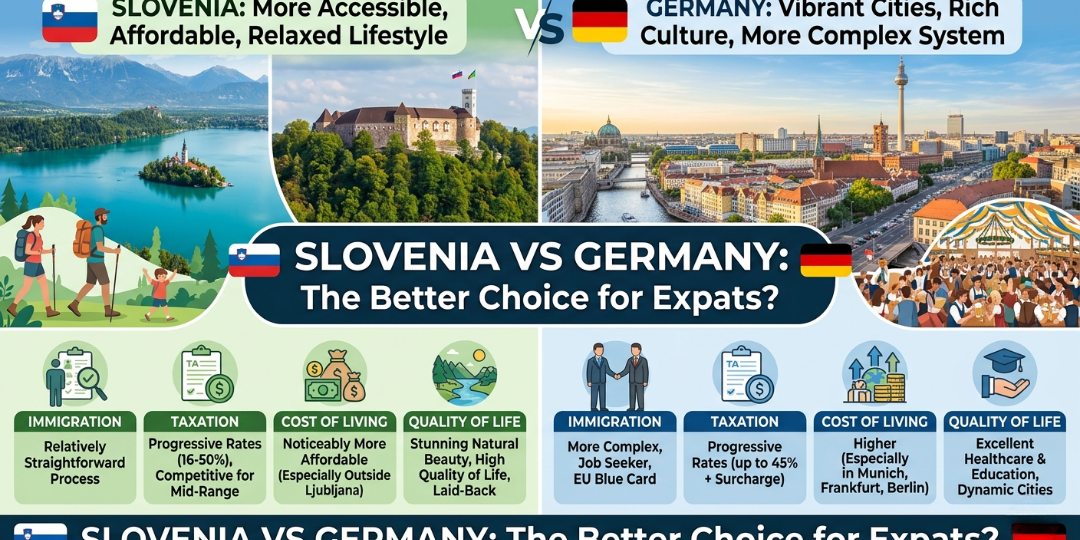
Slovenia vs Germany: The Better Choice for Expats?
When considering a move to Europe, many expats find themselves comparing various countries to find the best fit for their needs and preferences. Two countries that often come up in this comparison are Slovenia and Germany. In this article, we’ll take a closer look at how these two countries stack up in terms of immigration, taxation, cost of living, and quality of life for expats.
Immigration Programs
Slovenia has a relatively straightforward immigration process for expats:
- Temporary Residence Permit: Issued for employment, study, family reunion, or other purposes. It’s valid for up to one year and can be renewed.
- EU Blue Card: For highly skilled workers with a university degree and a qualifying job offer. Slovenia sets the minimum salary threshold at 1.5× the average gross annual salary in the country, which is recalculated each year based on official statistics.
- Permanent Residence Permit: Can be obtained after 5 years of continuous legal residence in Slovenia.
Germany, on the other hand, has a more complex immigration system:
- Job Seeker Visa: Allows you to stay in Germany for up to 6 months to find employment.
- EU Blue Card: For highly skilled workers. As of 2026, the general minimum salary threshold is €50,700 per year. For shortage occupations (IT, engineering, medicine, and others on the official list), a reduced threshold of €45,934.20 applies.
- Self-Employment Visa: For entrepreneurs who want to start a business in Germany.
- Family Reunion Visa: Allows close family members to join you in Germany.
Slovenia’s immigration programs are generally more accessible and less bureaucratic compared to Germany’s, making it an attractive option for expats.
Taxation
Slovenia uses a progressive personal income tax system with five tax brackets in 2026. The rates range from 16% on the lowest band of taxable income up to 50% on income above the highest threshold. The exact bracket boundaries are adjusted periodically, so expats should consult the Financial Administration of the Republic of Slovenia (FURS) for the current figures. Social security contributions for employees amount to approximately 22.1% of gross salary.
Germany also has a progressive tax system, with rates ranging from 0% (up to the basic tax-free allowance, which has been adjusted for 2026) to 45% on the highest incomes. An additional solidarity surcharge of 5.5% may apply to higher earners. Mandatory social security contributions in Germany — covering pension, health, unemployment, and long-term care insurance — typically total around 20% of gross salary for employees.
While both countries use progressive taxation, Slovenia’s top rates and overall tax burden tend to be somewhat lower than Germany’s, particularly for mid-range incomes. However, individual circumstances vary, and expats should seek professional tax advice before making a decision.
Cost of Living
Slovenia offers a noticeably more affordable lifestyle compared to Germany, especially outside the capital Ljubljana. Rent prices in Slovenia are generally lower than in comparable German cities, though the gap varies significantly depending on the specific locations compared. Dining out, groceries, and everyday services also tend to cost less in Slovenia.
Germany has a higher cost of living, particularly in larger cities like Munich, Frankfurt, and Hamburg. Berlin remains relatively more affordable compared to other major German cities, but costs have been rising steadily.
Expats can enjoy a high standard of living in Slovenia with lower overall expenses compared to most parts of Germany.
Quality of Life
Both Slovenia and Germany offer a high quality of life, with excellent healthcare, education, and infrastructure.
Slovenia boasts stunning natural beauty, with the Julian Alps, Adriatic coast, and Lake Bled being major attractions. Slovenia also has a rich cultural heritage, a thriving food and wine scene, and a more relaxed pace of life. Expats in Slovenia can enjoy a laid-back lifestyle while still having access to modern amenities.
Germany is known for its vibrant cities, rich cultural heritage, and world-renowned events like Oktoberfest. It also has a diverse landscape, from the North Sea coast to the Bavarian Alps. However, Germany’s larger size and population can also mean a more hectic pace of life, especially in bigger cities.
Conclusion
While both Slovenia and Germany are excellent destinations for expats, Slovenia offers several advantages:
- More accessible and straightforward immigration programs
- A competitive tax environment, especially for mid-range earners
- More affordable cost of living
- Stunning natural beauty and a relaxed lifestyle
If you’re looking for a welcoming, affordable, and picturesque country to call home, Slovenia might just be the perfect choice for your expat journey.