



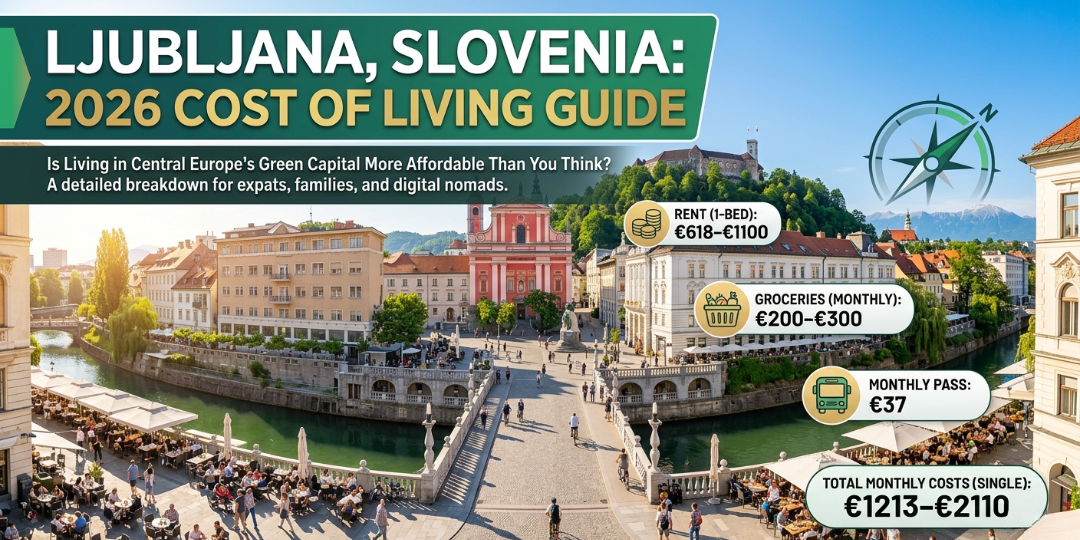
How Expensive Is It to Live in the Capital of Slovenia? Ljubljana Cost of Living Guide 2026
Ljubljana, Slovenia’s capital and largest city, is one of Europe’s best-kept secrets for expats, digital nomads, students, and families seeking a high quality of life without the crippling costs of Western European capitals. How expensive to live in the capital of Slovenia compared to cities like Vienna, Berlin, or Amsterdam? The answer will likely surprise you — in the best possible way. In this guide, we break down every major expense category so you can plan your move with confidence.
Ljubljana at a Glance
Slovenia’s capital sits at the heart of Central Europe, nestled between the Julian Alps and the Pannonian Plain. With a population of around 300,000, Ljubljana offers a cosmopolitan atmosphere — vibrant café culture, world-class museums, a thriving food scene, and easy access to nature — at prices that are 40–50% lower than in most Western European capitals.
Ljubljana is consistently ranked among the most livable cities in Europe for its safety, cleanliness, green spaces, and cultural richness. According to Numbeo, Ljubljana is the most expensive city in Slovenia, but it remains significantly cheaper than comparable European capitals.
Summary: Estimated Monthly Costs in Ljubljana
Before diving into the details, here is a snapshot of estimated monthly costs for living in Ljubljana in 2026:
| Expense Category | Single Person | Couple | Family of 4 |
|---|---|---|---|
| Rent (1-bed, outside center) | €618–€800 | — | — |
| Rent (2-bed, outside center) | — | €900–€1,200 | — |
| Rent (3-bed, outside center) | — | — | €1,200–€1,600 |
| Utilities | €150–€300 | €200–€350 | €250–€400 |
| Groceries | €200–€300 | €350–€500 | €500–€700 |
| Dining out | €100–€200 | €150–€300 | €200–€400 |
| Transport (monthly pass) | €37 | €74 | €100–€120 |
| Health insurance (supplemental) | €35–€110 | €70–€220 | €100–€300 |
| Internet & phone | €30–€50 | €30–€50 | €40–€60 |
| Entertainment & leisure | €50–€150 | €100–€200 | €150–€250 |
| Total estimated monthly costs | €1,213–€2,110 | €1,860–€2,870 | €2,550–€3,830 |
Housing Costs in Ljubljana
Rent is the single largest expense for residents in Ljubljana. Prices vary significantly depending on location, size, and condition of the property.
Rental Prices in Ljubljana (2026)
City center apartments:
- Studio / 1-bedroom: €740–€1,100 per month
- 2-bedroom: €1,100–€1,500 per month
- 3-bedroom: €1,500–€2,200 per month
Outside the city center (suburbs like Vič, Moste, Šiška):
- Studio / 1-bedroom: €618–€800 per month
- 2-bedroom: €900–€1,200 per month
- 3-bedroom: €1,200–€1,600 per month
Co-living spaces: €500–€1,500 per month depending on location and amenities — increasingly popular among digital nomads and young professionals.
Student rooms and shared apartments: €350–€500 per month.
Tips for Reducing Housing Costs
Living even slightly outside the city center — in nearby cities like Maribor or Celje — can reduce your rent by 15–25%. Many Ljubljana residents choose to live in suburbs with excellent public transport connections and enjoy significantly lower rents without sacrificing quality of life.
Utilities in Ljubljana
Basic utilities for an 85m² apartment in Ljubljana — including electricity, heating, cooling, water, and garbage — cost an average of €150–€300 per month. Costs vary significantly by season:
- Summer months: €55–€110 per month
- Winter months: €160–€330 per month (heating dominates)
Additional monthly utility costs:
- High-speed internet: €25–€40 per month
- Mobile phone plan: €10–€25 per month
Food and Grocery Costs
Ljubljana offers a wonderful variety of dining and grocery options, from budget supermarket chains to vibrant local markets and upscale restaurants, all without sacrificing quality.
Grocery Shopping
The average cost for weekly groceries per person in Ljubljana ranges from €60 to €80, translating to approximately €200–€300 per month. Budget-conscious residents shop at local markets and discount supermarket chains:
- Lidl, Hofer — budget-friendly, most items €1–€3
- Spar, Mercator — mid-range, wide selection including international brands
- Local markets (Tržnica) — fresh produce typically priced at €2–€6 per kilogram; fresh seafood and locally sourced items available seasonally
Key grocery price benchmarks:
- Chicken breast: approximately €5–€7 per kg
- Local cheese: €5–€10 per kg
- Bread (500g loaf): €1.50–€2.50
- Milk (1 liter): €0.90–€1.30
- Eggs (12): €2.50–€3.50
Monthly grocery costs in Ljubljana for one person: €200–€300 (cooking mostly at home).
Dining Out in Ljubljana
Dining out is relatively affordable in Ljubljana compared to most European capitals. Prices vary significantly depending on the type of establishment:
- Inexpensive restaurant meal: €10–€15 per person
- Mid-range restaurant, three-course dinner for two: €50–€65
- Upscale dining: €56 or more per person
- Coffee (espresso): €1.20–€2.50
- Local beer (0.5L, pub): €2.50–€4.00
- Meal at a fast-food chain: €8–€12
Many Slovenian cities, including Ljubljana, have a strong café culture where locals gather for coffee and conversation — a ritual that is both affordable and central to social life. You can enjoy a quality espresso for under €2,50 at most local cafés.
Transportation Costs in Ljubljana
Ljubljana has an efficient and affordable public transport network, and many residents live comfortably without a car. The city is also exceptionally walkable and bikeable.
Public Transport
- Single bus ticket: approximately €1.50
- Monthly public transport pass: approximately €37 — making it one of the most affordable monthly tickets in Europe
- Urbana card (rechargeable smart card): required for bus travel; available at kiosks throughout the city
Cycling
Ljubljana is one of Europe’s most bike-friendly capitals. The city has an extensive network of cycling trails and a public bike-sharing system (BicikeLJ):
- Annual BicikeLJ subscription: €3 (first 60 minutes of each ride free)
- Bike rental: €10–€15 per day
Car Ownership and Rentals
While a car is not necessary for living in Ljubljana itself, it is useful for exploring Slovenia’s countryside and nearby cities:
- Rental car rates: €30–€40 per day for a compact car; €40–€50 for mid-sized
- Gasoline prices: approximately €1.60–€1.80 per liter
- Monthly parking in the city: €50–€150 depending on zone
Healthcare Costs in Ljubljana
Slovenia’s public healthcare system is funded through social contributions and covers all registered residents. The cost of health insurance in Ljubljana is significantly lower than in the US or Western Europe.
Public Health Insurance
All residents who pay taxes and social contributions are covered by the compulsory public health insurance scheme (ZZZS). Employers typically contribute the majority of the premium.
Supplemental Insurance
Most residents purchase additional supplemental insurance (dopolnilno zdravstveno zavarovanje) to cover co-payments:
- Supplemental insurance cost: approximately €35–€110 per month depending on age
Private Healthcare
- Private specialist consultation: approximately $90-120 per visit
- The cost of health insurance in Slovenia typically costs less than $450 per month total
Ljubljana has modern medical facilities comparable to Western European standards, with shorter waiting times than many EU healthcare systems such as the UK’s NHS.
Education Costs in Ljubljana
For families with children, Ljubljana’s education system is excellent and largely free:
- Public primary and secondary schools: free for all residents (compulsory for ages 6–15)
- International schools: €8,000–€20,000 per year
- University tuition (state universities): €2,500–€4,500 per year for non-EU students; significantly reduced or free for EU citizens
- Ljubljana is home to the University of Ljubljana, one of the largest and most prestigious universities in Central Europe
Entertainment and Leisure
Ljubljana offers a comfortable lifestyle with a vibrant cultural scene, outdoor activities, and social life — all at very accessible prices:
- Cinema ticket: €7–€12
- Museum entry: €5–€15 (many museums offer free days)
- Gym membership: €25–€50 per month
- Hiking and cycling in the surrounding Julian Alps and Triglav National Park: largely free
- Day trip to Lake Bled: approximately €5–€15 (transport + entry)
- Ski pass (day): €30–€50 at nearby resorts
Ljubljana’s central location means easy access to world-class outdoor activities without high costs. Many Slovenian cities offer a wonderful natural playground right on the doorstep.
Can US Citizens Live in Slovenia?
Yes — US citizens can live in Ljubljana and Slovenia. For stays exceeding 90 days, a temporary residence permit is required. The most common pathways are employment, self-employment (registering a business), ownership of real estate or the digital nomad visa route. Once legally registered, US citizens have access to the same public services as other residents, including healthcare and education.
Can a US Citizen Buy a House in Slovenia?
Yes. US citizens can generally purchase property in Ljubljana and across Slovenia without completing a formal reciprocity check, due to historical trade agreements. Property prices in Ljubljana’s city center start at approximately €5,000–€6,000 per square meter, while suburban areas offer better value at €3,000–€3,500 per square meter.
Can I Speak English in Ljubljana?
Yes — Ljubljana is one of the most English-friendly capitals in Central Europe. Particularly among younger generations, English proficiency is very high. In restaurants, hotels, shops, and most service settings, you can comfortably get by with English. However, learning basic Slovenian will significantly enrich your experience and is appreciated by locals.
How Much Money Do I Need to Move to Ljubljana?
Here is a realistic relocation budget for moving to Ljubljana:
| One-time Costs | Estimated Amount |
|---|---|
| Security deposit (1–2 months rent) | €1,200–€2,200 |
| First month’s rent | €618–€1,100 |
| Residency permit application | €1250–€1750 |
| Furnishing / household setup | €500–€2,000 |
| Health insurance (first months) | €100–€300 |
| Emergency fund (recommended) | €2,000–€3,000 |
| Total one-time budget | €5,668–€10,350 |
For monthly living costs, a single person can live comfortably in Ljubljana on €1,500–€2,200 per month including rent. A couple should budget €2,200–€3,200 per month.
Ljubljana vs. Other European Capitals: Cost Comparison
| City | 1-bed Apt (center) | Monthly groceries | Monthly transport | Overall vs Ljubljana |
|---|---|---|---|---|
| Ljubljana | €740–€1,100 | €200–€300 | €30 | Baseline |
| Vienna | €1,200–€1,800 | €300–€450 | €51 | +60–80% |
| Berlin | €1,400–€2,000 | €300–€400 | €86 | +70–90% |
| Prague | €900–€1,300 | €250–€350 | €25 | +20–30% |
| Zagreb | €600–€900 | €200–€280 | €30 | -10–15% |
| Amsterdam | €1,800–€2,800 | €350–€500 | €97 | +120–150% |
Ljubljana is consistently cheaper than Vienna, Berlin, and Amsterdam while offering a comparable or superior quality of life in terms of safety, cleanliness, and access to nature.
Conclusion
Living in Ljubljana, the capital of Slovenia, is genuinely affordable by European standards — without sacrificing quality of life, safety, or cultural richness. Estimated monthly costs for a single person range from €1,200 to €2,100 depending on lifestyle, while a couple can live comfortably on €1,800–€2,900 per month.
Ljubljana offers a comfortable lifestyle with stunning natural beauty on its doorstep, a welcoming international community, excellent healthcare, and a public transport system that makes car ownership optional. Whether you are a remote worker, an expat family, a retiree, or a student — Ljubljana provides exceptional value for money in the heart of Europe.
The city may be Slovenia’s most expensive, but measured against the rest of Europe, it remains a hidden gem for those who know where to look.