



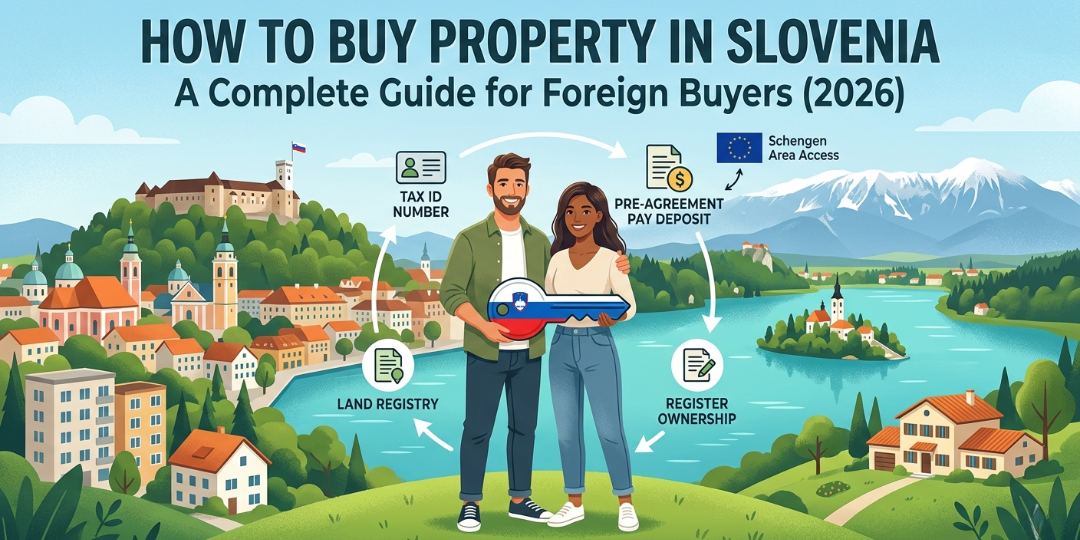
How to Buy Property in Slovenia: A Complete Guide for Foreign Buyers (2026)
Slovenia’s real estate market has been attracting growing international interest — and for good reason. Voted one of the top ten property investment locations in the world by the UK TV program “A Place in The Sun”, Slovenia offers stunning scenery, EU legal security, and solid rental yields at prices still well below Western European levels. Whether you’re looking for an apartment in Ljubljana, a villa near the Adriatic coast, or a countryside retreat in the Julian Alps, this guide covers everything you need to know about how to buy property in Slovenia as a foreigner in 2026.
Can a US Citizen Buy a House in Slovenia?
Yes — US citizens can generally acquire property in Slovenia. Since the United States is an OECD member state, US citizens are permitted to purchase real estate in Slovenia under the same principle that applies to citizens of other OECD countries. This means Americans do not need to undergo the reciprocity approval procedure that applies to certain other non-EU jurisdictions, making the process significantly more straightforward.
In practice, US citizens may purchase Slovenian real estate directly as private individuals. However, depending on the purpose of the acquisition — particularly in investment, rental, development or commercial-use structures — many buyers still choose to acquire property through a Slovenian company (d.o.o.), which can offer operational, liability and structuring advantages.
Is It Easy to Buy Property in Slovenia?
Buying property in Slovenia is considered manageable but requires careful preparation, especially for foreign buyers. The legal framework is transparent and EU-compliant, which means strong protections for buyers. That said, navigating the land registry, tax obligations, and legal entity requirements without local professional support can be challenging.
Key factors that make Slovenia real estate accessible:
- EU legal framework — transparent land registry and clear ownership records
- No restrictions for EU and OECD citizens — since Slovenia’s EU membership in 2004, EU, OECD, and EFTA citizens can purchase property under the same conditions as Slovenian citizens
- Growing market — residential real estate prices in Slovenia grow every quarter by an average of 2.2%
- Strong rental yields — investors can expect approximately 6% per year
Working with a local real estate lawyer (attorney) and a licensed notary is strongly recommended for all foreign buyers.
Slovenia Real Estate Market Overview 2026
Slovenia’s property market remains one of the most undervalued in the EU relative to quality of life. Key price benchmarks for 2026:
| Location | Price per m² (approx.) |
|---|---|
| Ljubljana city center | €5,000–€8,000 |
| Ljubljana outskirts | €3,500–€4,500 |
| Coastal areas (Koper, Piran) | €4,000–€6,000 |
| Julian Alps region | €3,000–€4,000 |
| Rural areas and smaller towns | €1,200–€2,500 |
For context:
- Existing apartments cost between €220,000 and €260,000 on average
- Detached countryside homes average €200,000–€280,000
- Rural houses with land parcels range from €130,000–€250,000
Compared to neighboring Italy and Austria, these prices represent exceptional value — particularly given Slovenia’s safety, clean environment, and EU membership.
Who Can Buy Property in Slovenia?
Foreign buyers in Slovenia are categorized into three legal groups:
1. EU, OECD, and EFTA Citizens
Citizens of EU member states, OECD countries (including the US), and EFTA nations can purchase real estate under the same conditions as Slovenian citizens — directly, as private individuals, with no restrictions.
2. Citizens of EU Candidate Countries
Citizens from EU candidate countries must apply for a formal reciprocity decision through the Slovenian Ministry of Justice before buying property. This process takes additional time and should be initiated early.
3. Other Non-EU Citizens
All other non-EU citizens must purchase property through a registered legal entity — typically a Slovenian d.o.o. (private limited company). To register a company, a non-EU buyer without a residence permit may need to obtain a work permit and demonstrate a minimum investment of €50,000 or proof of business income.
Step-by-Step: How to Buy Property in Slovenia
Here is the complete sequence of actions when buying property in Slovenia as a foreign buyer:
Step 1: Obtain a Slovenian Tax Number and EMŠO
Before any transaction, buyers must obtain a Slovenian tax identification number (davčna številka) and an EMŠO (personal identification number). These are issued by the Slovenian tax authority (FURS) and are required to proceed with any property transaction.
Step 2: Select the Property and Check Legal Status
Work with a licensed real estate agent and attorney to identify suitable properties and verify their legal status. Check for any encumbrances, debts, or legal disputes in the land register (Zemljiška knjiga). This step is critical — never proceed without a clean legal status confirmation.
Step 3: Open a Legal Entity (Non-EU Buyers)
If you are a non-EU citizen purchasing as an individual is not permitted, register a Slovenian d.o.o. (private limited company) before proceeding. This requires a minimum share capital deposit and registration with the Slovenian Business Register (AJPES).
Step 4: Sign a Pre-Agreement and Pay a Deposit
Once you’ve identified and verified your property, sign a preliminary purchase agreement (predpogodba) and pay a deposit — typically 10% of the purchase price. This secures the property and creates legal obligations for both buyer and seller.
Step 5: Prepare and Certify the Main Purchase Agreement
The main purchase contract (kupoprodajna pogodba) must be prepared and certified by a notary. Both parties sign in the presence of the notary, who also verifies the identities of all parties and the legal status of the property.
Step 6: Pay the Remaining Amount
The remaining amount of the purchase price is transferred from the buyer’s account via bank transfer — preferably through the notary’s fiduciary account. The funds are only released to the seller’s account once ownership registration is confirmed.
Step 7: Register Ownership in the Land Registry
The final step is registering the new owner in the land registry (Zemljiška knjiga). Your attorney or notary will typically handle this. Once registered, you are the legal owner of the property in Slovenia.
Costs and Taxes When Buying Property in Slovenia
Transfer Tax (Resale Properties)
For secondary real estate (resale properties), a transfer tax of 2% of the transaction amount applies. This is paid by the seller.
VAT (New Buildings)
For new apartments and buildings, VAT of 9,5 % applies. This significantly increases the purchase price for new builds.
Additional Costs
Property buyers in Slovenia incur additional costs ranging from 2.35% to 5.35 % of the purchase agreement value, depending on whether the property is new or resale. These include:
- Notary fees
- Land registry fees
- Attorney fees
- Real estate agent commission (typically 2–4%)
- Translation and apostille costs for foreign documents
Example: When purchasing a new apartment worth €500,000, the total cost including all additional expenses can amount to approximately €526,750.
Rental Income Tax
If you plan to rent out your property, rental income is subject to income tax in Slovenia. The standard income tax rate on rental income is 25%, though deductions for maintenance and depreciation are permitted.
Capital Gains Tax
Capital gains from property sales are taxed in Slovenia. The rate decreases the longer you hold the property, incentivizing long-term investment.
Mortgage Options for Foreign Buyers
Obtaining a mortgage as a foreigner in Slovenia is selective and closely tied to residency status and income currency.
- Slovenian residents earning in euros can access standard mortgage terms with down payments typically around 20–30%
- Non-residents may be required to provide a down payment of 30–50% due to stringent lending conditions
- The Bank of Slovenia enforces a Debt-Service-to-Income cap, allowing monthly debt obligations not to exceed 50–67% of net income
For most foreign buyers without Slovenian residency, purchasing with cash or through a foreign mortgage is more practical than seeking financing from Slovenian banks.
Why Invest in Slovenian Real Estate?
Beyond the lifestyle benefits, Slovenia property investment makes strong financial sense:
- Quarterly price growth of approximately 2.2% — consistent and stable
- Rental yield of approximately 5% per year — competitive within the EU
- EU legal security — your ownership rights are protected under European law
- Gateway to the Schengen Area — property ownership can support residency applications
- Tourism growth — particularly in Ljubljana, Bled, and the Adriatic coast, driving short-term rental demand
- Undervalued market — prices remain significantly below comparable EU destinations like Italy, Austria, and Slovenia’s Adriatic neighbors
Slovenia’s geographical position in Central Europe also provides easy access to both Western and Eastern European markets — attractive for investors considering commercial real estate or short-term rental strategies.
Practical Tips for Foreign Buyers
- Hire a bilingual real estate agency or attorney — Slovenian real estate law is complex for foreigners; legal support is essential
- Use a notary’s fiduciary account for all payments — this protects both buyer and seller
- Get your tax number (davčna številka) early — you cannot proceed without it
- Verify the land registry for any encumbrances before signing anything
- Budget for additional costs — plan for at least 3-5 % above the purchase price for taxes and fees
- Consider the legal entity route carefully — a d.o.o. has ongoing accounting and compliance obligations
- Check building permits if purchasing land or a construction project — a building permit is mandatory for any new construction in Slovenia
Conclusion
Buying property in Slovenia as a foreigner is entirely achievable — and increasingly attractive in 2026. With a transparent legal system, strong investment fundamentals, and access to one of Europe’s most beautiful and underrated countries, Slovenia real estate offers genuine value for both lifestyle buyers and investors.
The key to a smooth purchase is preparation: understand your legal category as a foreign buyer, obtain the necessary tax identification numbers, work with qualified local professionals, and ensure all payments flow through secure, verified channels.
Whether you’re drawn to a Ljubljana city apartment, a coastal retreat near the Adriatic, or a mountain chalet in the Julian Alps, Slovenia’s property market is ready to welcome international buyers — with the legal framework and the scenery to match.
For personalized guidance, contact a licensed Slovenian real estate or consult the Slovenian Ministry of Justice for reciprocity information relevant to your nationality.